
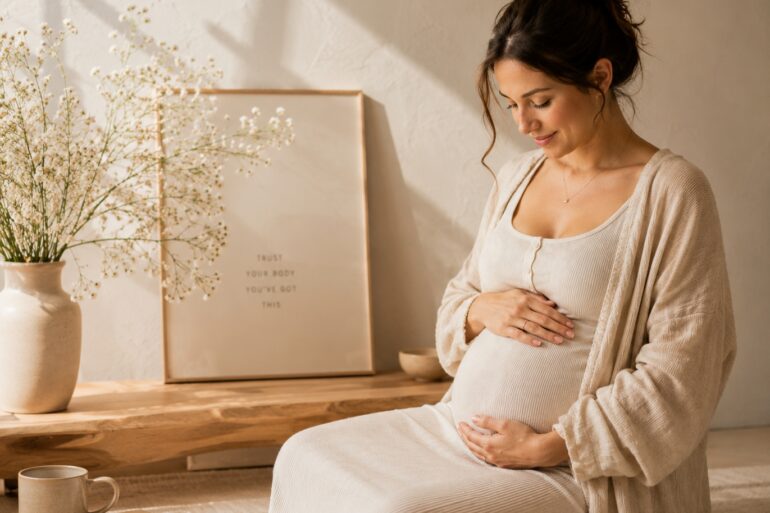
As someone who was afraid of giving birth for a long time, I first had to reach a point where I truly wanted to have a child. Along the way, I explored different approaches and searched for answers to the question of how to prepare for a natural birth and make the experience easier. I paid particular attention to the positive birth stories of women who had natural births, as well as to the approach and experiences of midwives in England and Austria.
All of that knowledge led not only to my desire to become a mother, but also to going through pregnancy and birth without fear and with complete trust in my body.
My baby was born at 39+3 weeks, just two hours after arriving at the midwife-led birth center, without complications, and we were able to go home the very same day. Was the birth painless? No. But it was an intensity I was able to follow and stay in control of — and which, for me, was completely manageable.
The biggest change was that, instead of fear, I began to feel trust in my body.
That’s why I’m sharing what helped me.
1. Mental Preparation for a Natural Birth
For me, mental preparation was the most important part of preparing for a natural birth.
It included a course that explained what happens during labor and birth, as well as how to make informed decisions throughout the process. This preparation helped me approach birth not with fear of the unknown, but with the confidence that I understood what was happening and what my options were. The course covers positions that can help your baby move through the birth canal more easily, creating an environment that supports a sense of safety, how stress and fear hormones can influence labor, and common medical procedures—when they are truly needed and what they involve. What I found especially valuable was that the course doesn't idealize birth. Instead, it offers a realistic perspective and practical tools to help you move through the experience with greater confidence and understanding.
👉 Course link: https://thepositivebirthcompany.com/
2. Nutrition
Since I've paid close attention to my nutrition for many years, and based on recommendations from midwives in Austria, I chose not to take prenatal supplements during pregnancy (except for folic acid during the first trimester), while regularly monitoring my blood work. This approach made sense to me because some studies suggest an association between prenatal supplementation and increased birth weight, which may make birth more difficult. This was my personal choice, and at the end of this article I've included links to some of the relevant research for anyone who would like to explore this topic further.
My diet centered around smoothies made with fresh fruits and vegetables, often using baby spinach and lemon as a base for their natural iron content. Since my body was already used to spirulina and barley grass juice powder before pregnancy, I occasionally added them to my smoothies as well. Among superfoods, I also frequently included wild blueberries.
When it came to protein, I mostly focused on plant-based sources such as quinoa, peas, and other legumes, along with eggs, turkey, chicken, and fish. I also regularly ate salads with my meals, especially lamb’s lettuce, iceberg lettuce, and baby spinach. I naturally avoided red meat because it didn’t feel good for my body, and throughout pregnancy I also tried to minimize my intake of refined sugar, as well as gluten after week 35.
3. Movement and Exercise
Movement and exercise were also an important part of my preparation for birth. During the first few months, I rode my bicycle, and later I transitioned to daily walks and gentle yoga exercises focused on opening the pelvis, especially during the third trimester. This type of movement helped me stay active, connected to my body, and genuinely feel good throughout pregnancy.
4. We Didn’t Tell Anyone the Exact Due Date
Questions like “When’s your due date?” or “Any signs yet?” often come from a good place, but as birth approaches, they can create an additional sense of pressure and expectation. That’s why we decided not to tell anyone the exact due date and to keep communication limited to what felt good for us in that moment. For me, this wasn’t about shutting people out, but about protecting my sense of calm, focus, and relaxation before giving birth.
5. My Birth Environment Fully Supported My Vision of a Natural Birth
After taking the course I mentioned, and after having a somewhat challenging experience with doctors during pregnancy, I decided to give birth in a birth center run by midwives. That environment fully supported my vision of what birth could look like — calm, safe, and deeply respectful of the body. For me, that meant dim lighting, a relaxed atmosphere, complete respect for my body and my pace, no rushing, and questions like: “Would it be okay if I check how dilated you are?” It also meant having the freedom to accept or decline any examination. I was able to eat and drink whenever I wanted, move freely, and change positions throughout labor. My baby’s heart rate was monitored with a handheld Doppler device, without routine interventions that could disrupt the natural flow of labor. And perhaps the most beautiful part — my baby was placed on my chest immediately after birth and stayed there while the blood from the placenta naturally transferred to the baby.
I believe that an environment in which a woman feels safe, the support of an experienced midwife, and the presence of a partner can have a significant impact on the birth experience. That does not mean that medicine is the problem — on the contrary, it is invaluable when truly needed. But the way care is communicated, the feeling of support, and a woman’s ability to maintain trust in herself can make an enormous difference.
6. Raspberry Leaf Tea, Dates, and Herbal Steam Baths
Starting from week 35 of pregnancy, I began drinking raspberry leaf tea (1 cup, 2–3 times a day) and eating 6 dates per day. Raspberry leaf tea has traditionally been used as support for uterine tone and preparing the body for contractions, while some studies suggest that eating dates during the final weeks of pregnancy may be associated with a more spontaneous onset of labor and a reduced need for certain interventions.
During the final weeks of pregnancy, I also used a herbal steam bath with meadow flowers (Heublumen Dampfbad), which is traditionally used in some European approaches to birth preparation. The purpose of this practice is to relax the pelvic area, improve circulation, and create a sense of warmth and relaxation in the body. This type of steam bath is most commonly done 2–3 times per week for around 20 minutes, and I personally did it twice during week 38 of pregnancy.
7. Sitting on a Pilates Ball
From the moment my belly started growing more noticeably, I often sat on a Pilates ball instead of a regular chair. It helped me feel more comfortable, gently move my pelvis, and reduce tension and stiffness in my lower back.
8. Videos of Positive Natural Birth Experiences
Watching videos of women who had positive natural birth experiences also made a huge difference for me. It helped me move away from fear and begin believing that I, too, could go through birth calmly and safely, while also creating a completely different image of what childbirth could be. Instead of seeing it as something that necessarily had to be traumatic, I began to experience it as a deeply powerful experience for a woman bringing new life into the world. It also helped me develop more trust in the female body and its natural ability to move through this process when supported by safety, trust, and the right environment.
9. Meditation, Breathing, and Relaxation
My evening routine during the third trimester included around 30 minutes of yoga exercises focused on opening the pelvis and supporting my lower back, followed by a guided meditation in which I imagined holding my baby in my arms. Moments like these helped me connect with my baby and begin replacing fear with a sense of calm and trust.
I practiced breathing and relaxation exercises while listening to the music I had planned to use during labor as well. Even though everything happened very quickly in my case and we never got the chance to play the playlist, this preparation helped me feel a familiar sense of safety and calm once labor began.
10. What Can Make a Natural Birth More Difficult
In the final weeks before birth, it’s important for the rhythm of life to support relaxation — enough sleep, a slower pace, and as little as possible that increases stress levels. Elevated stress hormones, such as cortisol, can affect how and when the body feels ready for labor, which is why it can be helpful during this period to choose activities that calm both the body and the mind. This can also include listening to negative birth stories, feeling that everything must be finished and perfectly organized before the baby arrives, or even intense gym workouts, which are often considered acceptable during pregnancy, but personally did not feel aligned with the state of relaxation I wanted to create before giving birth.
Every woman has the right to choose what feels best for her and her baby. There is no single right way to prepare for a natural birth. What helped me most was making decisions based on understanding what was happening and trusting my body, rather than acting out of fear. The way you prepare doesn't guarantee how your birth will unfold—but it can make the experience significantly easier and completely change the way you experience it.
Relevant studies and sources:
• Kawai K. et al. Effects of prenatal multimicronutrient supplementation on pregnancy outcomes.
https://pmc.ncbi.nlm.nih.gov/articles/PMC2691425/
• Prenatal multivitamin supplementation increases birth weight. International Journal of Reproduction, Contraception, Obstetrics and Gynecology.
https://www.ijrcog.org/index.php/ijrcog/article/view/2652
• Scholl TO. et al. Maternal Iron and Folic Acid Supplementation and Pregnancy Outcome. The Journal of Nutrition.
https://www.sciencedirect.com/science/article/pii/S002231662201272X